
คดีรถชน + การเคลมประกัน คู่มือสมบูรณ์
Car Accidents & Insurance Claims — Complete Guide
คดีแพ่ง
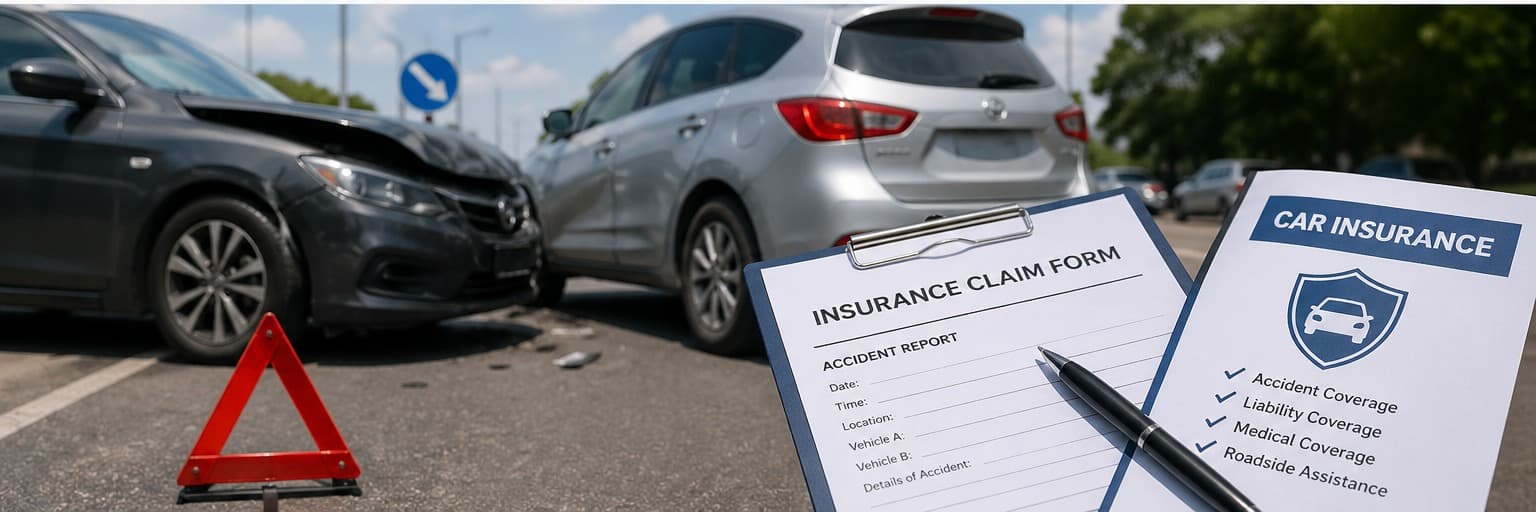
Car Accidents and Insurance Claims
Road accidents occur daily in Thailand, and the aftermath involves more than vehicle damage and injuries — it includes coordinating with insurers, determining fault, and sometimes pursuing litigation. Knowing the proper procedure from the first minute after an accident protects your rights and ensures full compensation.
Applicable Law
- Compulsory Motor Insurance Act B.E. 2535 (1992) — Mandatory CMI ("Por Ror Bor") for all vehicles.
- Land Traffic Act B.E. 2522 (1979) — Criminal offenses related to driving.
- Civil and Commercial Code Section 420 — Tort liability.
- Civil and Commercial Code Section 437 — Strict liability of vehicle possessor or controller.
- Criminal Code Sections 291, 300 — Causing death or injury through negligence.
Types of Motor Insurance — Know the Difference
1. CMI (Compulsory Motor Insurance — "Por Ror Bor")
Required for every vehicle. Annual cost: a few hundred to a thousand baht. Covers personal injury only (driver, passengers, pedestrians); does not cover property. Coverage limits:
- Medical expenses: up to THB 30,000 (initial), up to THB 80,000 (with proof of fault)
- Death/permanent disability: THB 500,000
- Loss of organ: THB 200,000–500,000
2. Voluntary Insurance — Five Tiers
| Tier | Other party's vehicle | Own vehicle | Fire/flood/theft |
|---|---|---|---|
| Class 1 | ✓ | ✓ | ✓ |
| Class 2+ | ✓ | ✓ (collision only) | ✗ |
| Class 2 | ✓ | ✗ | ✓ (fire/theft) |
| Class 3+ | ✓ | ✓ (collision only) | ✗ |
| Class 3 | ✓ | ✗ | ✗ |
Immediate Steps After an Accident
- Assess damage and safety — Anyone hurt? Is the vehicle blocking traffic?
- If injured — call 1669 — Medical emergency.
- Turn on hazard lights and place warning triangles
- Take photos and videos — Multiple angles of the scene, vehicle damage, license plates, road and traffic markings.
- Exchange information — Names, IDs, phone numbers, driver's licenses, vehicle registration, and each party's insurance company.
- Call your insurance company — Both parties call their own. Adjusters typically arrive in 30 minutes to 2 hours.
- Notify police — For accidents involving injury, significant property damage, or where fault is contested.
- Keep medical receipts — If treated at a hospital.
Never: Admit fault at the scene, settle for cash without documentation, or leave the scene before police or insurers arrive.
Determining Fault
Liability depends on traffic rules and evidence. The party violating traffic laws is generally at fault.
- 100% fault — One party fully responsible
- Comparative fault — Apportioned, e.g., 70:30
- 0% fault — Not responsible
Traffic police make a preliminary determination and issue a "Daily Record" — a key piece of evidence. Disputes can be brought to court.
Recoverable Damages
- Repair costs — Per garage estimate
- Medical expenses — Actual receipts
- Loss of vehicle use — While in repair, THB 500–1,500/day
- Lost income — During recovery
- Diminution in value — A new car loses value even after repair
- Pain and suffering — For serious injury
- Funeral expenses and family support — In death cases
Filing an Insurance Claim
- Notify within 24 hours — Insurers operate 24-hour call centers.
- Submit documents — Daily Record, photos, repair quotes, medical certificates.
- Damage assessment — The insurer dispatches an adjuster.
- Repair approval — Approved at network or non-network garages.
- Recovery from the other party — The at-fault party's insurer pays; if uninsured, the individual is sued directly.
When and Where to Sue
When to Sue
- The at-fault party is uninsured and refuses to pay
- The insurer denies the claim
- Damages exceed the other party's policy limits
- Disputed apportionment of fault
Court of Jurisdiction
- Magistrate Court — Claims up to THB 300,000
- Civil Court — Claims over THB 300,000
- Consumer Court — Direct suits against insurance companies, no filing fee
Limitation Periods
- Tort (collision) — 1 year from learning of the wrong and the wrongdoer
- Tort that is also a criminal offense — Use the longer criminal limitation (5–10 years)
- Insurance contract — 2 years under Section 882 of the Civil and Commercial Code
Hypothetical Case Studies (Educational)
Case 1 — Clear rear-end collision: Mr. A rear-ends Mr. B who was waiting at a red light. Both have Class 1 insurance. Mr. B's repair costs THB 50,000; Mr. A's costs THB 30,000. Mr. A's insurer pays Mr. B; Mr. A uses his own Class 1 to repair. Resolved in one month.
Case 2 — Comparative fault: Mr. C exits a soi without checking and hits Ms. D, who was speeding. Police find C 70% at fault, D 30%. Total damage THB 200,000. D recovers THB 140,000; D pays C 30% of C's damages.
Case 3 — At-fault driver uninsured: Mr. E's motorcycle hits Mr. F's car. E is at fault but uninsured. F uses his Class 1 first to repair, then F's insurer sues E directly to recover.
Common Mistakes
- Admitting fault at the scene — Wait for police and insurer assessment.
- Not photographing or photographing poorly — Hard to prove fault.
- Settling for cash at the scene — Can't claim more if damage exceeds the agreement.
- Not notifying insurer within 24 hours — Coverage may be denied.
- Leaving the scene — Criminal offense ("hit and run").
- Signing documents without reading — Some contain release-of-rights language.
Frequently Asked Questions
What if I don't have Class 1 insurance?
If you're not at fault, claim from the other party directly or from their CMI for personal injury. If you're at fault, you pay yourself.
Who's liable when hitting an animal?
Owners are liable under Section 433 if their animal escapes onto the road, but the driver may share responsibility for failure to drive carefully.
Does insurance cover drunk-driving accidents?
Insurance covers the other party (the victim) but not the drunk driver's own vehicle. The drunk driver must reimburse the insurer for what was paid to the victim.
Who's liable when driving a borrowed car?
The driver is liable as the wrongdoer; the owner is jointly liable under Section 437 as the possessor.
How long does a car-accident case take?
Insurance claims: 1–3 months. Court litigation: 6 months to 2 years depending on complexity.
Conclusion
Car accidents involve civil, criminal, and insurance law. Following the correct procedure from the first minute — especially preserving evidence and refusing to admit fault at the scene — has a major impact on compensation. For significant damages or fault disputes, consult a lawyer to assess your rights and plan an appropriate course of action.
Related Topics
Note: The information on this page is for general educational purposes only and not specific legal advice. If you have a case or need guidance, please contact a lawyer directly at 081-544-0944